
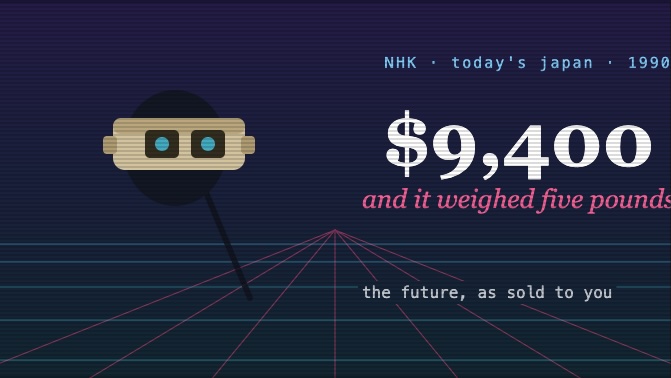
In 1990, NHK’s Today’s Japan aired a dispatch from tomorrow. Tomorrow, it turns out, looked like a man in beige goggles waving a gloved hand at objects only he could see, while a narrator gently explained “artificial reality” to a nation that had wisely not yet paid for it.
The man is Jaron Lanier, and the gear is VPL Research’s greatest hits: the EyePhone and the DataGlove. The EyePhone weighed 5.5 pounds and cost $9,400 — roughly a used car’s worth of headache, delivered directly to your cervical spine. You didn’t wear it so much as enter into a hostage negotiation with it. And that was the cheap one; the deluxe HRX model ran to $49,000, a figure that assumes your face is a capital expenditure.
Then there’s the DataGlove, which the segment presents as the key to touching a world that isn’t there. It’s a beautiful object — genuinely, it is — and it also perfectly captures the era’s core move: build one astonishing demo, film it under studio lights, and let everyone at home fill in the ninety percent that doesn’t work yet. The glove could point. The glove could grab. The glove could not, whatever the narrator implied, hand you the future. But it photographed like it could, and in 1990 that was the entire industry.
Lanier does what Lanier does, promising to “transport your sensory system into a reality that can be of any description.” Magnificent. Bulletproof. Also completely unfalsifiable, which is precisely why the same sentence has survived thirty-five years of keynote stages without a single edit. Matte-black the housing, lop two zeros off the price, and you could ship this script to a product launch next week and nobody would flinch. The vocabulary has been sanded down — “immersive,” “presence,” “spatial computing” — but the promise underneath is word-for-word identical: come inside, leave your body at the door, we’ll take it from here.
What the NHK crew couldn’t have known is how the story ends, or rather how it keeps ending. VPL — the company that coined “virtual reality,” that supplied the actual hardware for The Lawnmower Man two years later — was already circling the drain even as this segment aired, and would spend the decade sliding toward bankruptcy while its patents were eventually scooped up by Sun. The most photographed VR company on Earth couldn’t make the math work. The gear was real. The wonder was real. The business was a rumor.
And that’s the part worth sitting with. Watch the volunteer’s slow, careful head-turns, the way everyone in frame treats a low-res wireframe cube like a moon landing, and you’re not watching primitive technology fail to keep a promise. You’re watching the promise get made, fully formed, in its final shape. Everything since — every resolution bump, every foveated whatsit, every “no really, this time it’s ready” — has been an argument about the hardware, not the pitch. The pitch was finished in 1990. We’ve just been waiting for the goggles to catch up to a sentence.
For those of us who were there, footage like this isn’t nostalgia. It’s a receipt. It’s proof of what we were sold, at what price, in what font, before most of the people currently reinventing this stuff had learned to walk. The wave came in, left its wreckage, and went back out — and it’s out there now, gathering itself for the next run at the beach.
Bring a towel. And maybe a neck brace.
